Mirror, Mirror…
April 16, 2010 § Leave a comment
I’ve had an interesting journey with the way dancing feels versus the way it looks.
When I first began dancing away from a mirror (in performance, for example), belly dance was still very new to me. When I didn’t have a mirror to look at, I could still tell I was doing a move because I had to put a fair amount of effort and concentration into it.
Later, around my third or fourth year of dancing, I went through a strange transition. Many moves had started feeling more natural, and I could no longer tell how much I was doing with my hips. When looking in a mirror, I could see the moves were bold and defined, but they didn’t feel big any more.
This went on for the next couple years. When I took workshops without a mirror, sometimes I was told I was trying to make a move too big. Sometimes I put my hands on my hip bones to make sure they were doing what they were supposed to be doing. Perhaps I had developed some sort of mirror dependency, but mostly I think I had reached a point in my dancing where some moves felt effortless, and that was new to me.
There is one instance that the opposite thing occurred: learning continuous hip shimmies (vibrational shimmies, piston hip shimmies, freeze shimmies, etc.). These are very challenging and I had greater success if I focused only on feeling each hip moving up and down alternately and not on how the shimmy looked. When I would look at myself, my shimmies would freeze up or stutter. The mirrors were working against me. Looking back, it may have been a self-conscious, mental block. Because these shimmies are so challenging, seeing myself try to execute the move probably just pulled my focus to my not being that good at them and away from concentrating on getting the move to happen.
It’s only in the last couple years all this has resolved itself. Now, unless I’m doing something that’s really new to me, I can usually tell what my hips are doing and how big, with or without a mirror.
I think a major aspect of learning to dance is a shifting of focus between how a move looks and how it feels, until eventually the two become aligned. Perhaps that’s one way to define mastering a move.
TribalCon VI, 2010
April 1, 2010 § Leave a comment
Once again, I had a great TribalCon experience. This year, I only came to the Friday night hafla and Saturday workshops and show.
The hafla was fun. I saw more ATS this year than I did last year. There was less poi spinning and a bit of hooping. Something new was African dancing, which I hadn’t seen at a hafla before. That was really awesome. Also, there were a few more male belly dancers participating in the convention. Notably, the ATS troupe Shades of Araby was there. They have a male troupe member and came all the way from Toronto. They are a very fun troupe to watch.
My favorite workshops were Ariellah’s and Asharah’s.
Ariellah’s “The Artist’s Workshop: A primer for the well-rounded dancer”, was very interesting and thought-provoking. We addressed many conceptual ideas about dancing, music interpretation, execution and expression. We explored what moves us to dance, why we dance, how we envision ourselves sharing those things with an audience, and what qualities we want to possess when we dance. During one really cool exercise, we listened to various songs and wrote down the temperature of each, the color and whether or not it evoked a memory. Then, Ariellah taught us some combos, but insisted that we didn’t just go through the movements, that we actually danced the combos. My favorite TribalCon quote was from after Ariellah had us do an arm movement as if we were touching velvet drapes with our finger tips. A student in the class shared how much she was able to imagine that she could actually feel the drapes. Ariellah told her, “That mental memory is going to become muscle memory, and it’s going to be beautiful.”
Asharah’s “Salimpour Legacy in Tribal” workshop was incredibly interesting. She discussed the history of Tribal Belly Dance and how the dance morphed a little with each student becoming teacher. Jamila Salimpour is credited with establishing a common language in the dance. Many of the names for movements we use today were coined by Jamila. Jamila directed the first Tribal-like troupe, Bal Anat. She was Masha Archer’s teacher, who was Carolena Nericcio’s teacher. When Carolena began teaching, American Tribal Style was developed, somewhat unintentionally, to meet the needs of her and her dancers. On the other side of Tribal, Rachel Brice was a member of Ultra Gypsy at the time she developed and named Tribal Fusion. She was the first Tribal dancer to take the dance solo. Ziah of Awalim was in the class and shared that she was at the Tribal Fest where Rachel Brice debuted her solo Tribal Fusion style. Ziah said at the time they thought it was kind of funny and the general reaction was, “Hey, look! That Ultra Gypsy girl is dancing all by herself!” We can thank Jamila’s daughter, Suhaila Salimpour, for refining the muscle technique to be more in line with other dance forms. My favorite part of the workshop was when we danced through the moves as they were originally executed by Jamila and compared them to how they are executed today in American Tribal Style. The moves are very similar, but the ATS versions have been modernized and altered to fit the music style and format of ATS. One of the common changes occurs in the timing and where the downbeat and upbeat fall. For example, Jamila’s Basic Egyptian was “step, twist, step, twist”, and the American Tribal Style version is “twist, step, twist, step.”
The Saturday show was beautiful. It was a whopping 3 hours! There was a lot of lyrical, modern-inspired pieces. Unfortunately, there were sound problems much of the night. It turns out a whole amp was turned off for the entire show. The music didn’t fill the auditorium the way you’d expect during a dance show, and the mic levels for the live musicians were imbalanced, but it was still a pretty show.
My troupe is still waiting on our performance video, but here are two of my favorite performances of the evening. The first is Jahara Phoenix and the second is their student troupe, Sherar.
American Belly Dance: Tribal Versus Cabaret
March 1, 2010 § Leave a comment
Recently I was at a hafla at my dance studio and someone asked if she could start coming to my ATS classes. I said of course she could and told her what to bring and what to expect about the class structure and dance style. I explained how it would be different from other styles of belly dance.
This got me thinking about the notorious battle between Tribal and Cabaret. I personally love all styles of belly dance and know many other dancers that do as well, but it’s still there and talked about often enough in the belly dance community. It occurred to me that in ways American Tribal Style really is the antithesis of American Cabaret.
For example, I was talking about how she should bring zills with her to class, but explained that the zill patterns are coupled with particular dance moves, not specifically what rhythm the drum is playing. We learn the moves specific to ATS, a particular way to execute them, and the cue for each. We learn to dance in synchronization without a choreography.
With Cabaret, the zills usually reflect or play off of the drum rhythms and may be layered over any dance move. There are endless variations for each move and group pieces are usually choreographed.
Tribal dances are often beat driven; Cabaret tends to spend more time on the melody.
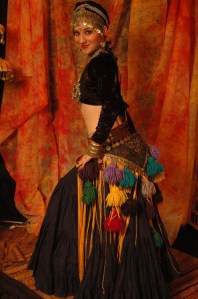
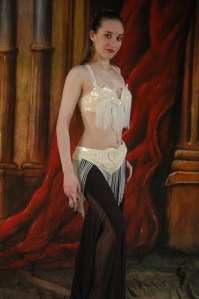
Tribal is earthy; Cabaret is airy.
Tribal is dark; Cabaret is light.
Tribal: coins and cotton, Cabaret: sequins and chiffon.
Looking Forward to TribalCon!
February 11, 2010 § Leave a comment
I am really looking forward to attending TribalCon again this year. This will be my third year. The classes are diverse and educational, and my troupe has some really fun things planned for our performance.
I am especially looking forward to Asharah’s class on the legacy of Salimpour technique in Tribal Belly Dance. She will talk about how Tribal came to be and about the roots of the American Tribal Style dance moves. This should be very interesting. I enjoyed Asharah’s ticking class last year and am looking forward to seeing what else she has in her arsenal.
I am also looking forward to taking Megha’s dynamic fades workshop. I wonder if there will be new fade moves or just reviews and clarifications of the current ones. The class description specifically said we would be reviewing the ASWAT (Arabic Shimmy with Arms and Turn) which I learned in a TribalCon workshop two years ago. Whether there is new material or not, it is always interesting and valuable to take classes from other ATS instructors and see how they break things down.
I am sad I will not be attending the entire weekend because I will be missing the workshops taught by Donna Mejia. I loved her classes last year and think she is an absolutely amazing woman and beautiful dancer. Oh well, hopefully I will have an opportunity to take classes with her again one day.
As always, I am really looking forward to the Friday night hafla, which is such a blast!, and the never-disappointing Saturday night show!
This is the host troupe, Awalim, performing at the Saturday show in 2008:
Only two more weeks!
American Tribal Style!
January 13, 2010 § Leave a comment
I have been watching the Fat Chance Belly Dance DVDs. There are still a couple I don’t have access to (I am borrowing the ones I have right now) but plan on buying those soon. As I watch these, a couple thoughts come to mind.
First of all, my ATS training was far more accurate to the Fat Chance Style than I ever realized. I’m not really sure why I thought it wasn’t. I guess it was because I hadn’t watched the DVDs myself and as my class learned more, my teacher had us add in details. It seemed like we were modifying things when we were usually just refining them.
Second, it’s interesting to me that I have been able to witness some of the more recent evolutions of the dance language. There are moves that were not in the Fat Chance language that I learned or saw from other troupes that have now made their way onto the most recent DVD, Tribal Basics, Vol. 7: Creative Steps & Combinations.
At Tribal Fest 3, my dance troupe learned a new move using a turning double hip bump that hit all four corners of a personal box. I believe the troupe we learned it from called it “The Spider.” The way they presented it, the arms were positioned out to the side when facing the front, and over head when facing the back. We adopted this move into our local ATS language. Several years later, I got a hold of Creative Steps and Combinations and discovered that a variation had found its way into the official dance language, but with different arms and the name “Chico Four Corners.” I really like the new arm positioning and now perform and teach it that way.
Another example is the Double Back. I had seen many other troupes perform versions of this move over the years, but had never done it myself until I watched Creative Steps and Combinations. Now it is one of my favorite moves.
The next thing I noticed when watching the DVDs is that the intention of how the dance information be used seems to have changed over time. On the revised Tribal Basics, Vol. 1, Dance Fundamentals, Fat Chance Belly Dance founder and director, Carolena Nericcio, says the moves included on the DVD are the “Tribal Basics according to Fat Chance Belly Dance.” I generally didn’t notice any implication that using different basic moves or variations of the basic moves would be considered incorrect or would not be true American Tribal Style. Perhaps this is a relatively new idea.
On Tribal Basics, Vol.6: Improvisational Choreography, Carolena talks about ATS.
“The concept of American Tribal Style Belly Dance is interpreted differently all over the world, but the idea that seems to repeat itself over and over is that of dancers enjoying each other, celebrating their bodies, and honoring the music with movement.”
Carolena used to annually teach workshops and guest star in a big show with my old troupe. It was in one of these workshops, around 2003, that I first heard her say that she thought the ATS language should be formalized. She said she thinks it should be like ballet and everyone should have the same form as her, but since it wasn’t that way, it was important that everyone in a single troupe at least use the same form as each other. Perhaps in the beginning, Carolena was not particularly direct about this because she could not have foreseen the explosion of variations her dance form would spawn.
This explosion has also led to the dance form having to be referred to more formally as “American Tribal Style” or “ATS” since the simple term “Tribal” has become all-encompassing to include any variations that have some similarities in stylization, costuming, or the feel or intention of ATS.
Watching these DVDs has been a very good experience for me. It has been a refresher on some of the finer details and I have learned a couple things I either didn’t know before or have forgotten from lack of use (such as a trio having the option of dancing in a diagonal line; I only recall regularly using a triangle).
Also, I can now tell my students what exactly is a classical ATS move and/or cue and what is an addition so they will know what to expect when they venture outside our local ATS community. Dance is a universal language, and American Tribal Style is a fun conversation.
Improvements in Improv
December 30, 2009 § Leave a comment
I used to be so incredibly afraid of performing improvisational belly dance that I would all but refuse to do it. If there was a way to get out of it, I would.
In the past couple years, with much pushing from my dance troupe director, I’ve started doing it much more. At first, I was nervous and self-conscious and wondered if I was doing the correct thing to the music. Was I being impressive enough? Did I look like a good dancer?
My comfort level started to improve with open dances after hafla performances. Dancing improvisationally with a bunch of other dancers in an informal setting mixed with post-performance adrenaline helped me feel less self-conscious and be able to just have fun and dance.
At a benefit show we did a couple months ago, one of our musicians was unexpectedly unable to make it. This meant we couldn’t do each choreographed dance we had planned since she played a major role in the melody of certain pieces. To fill in the space, we, with members from our student troupe, took turns improvising to some music that we all knew well. It was in a Mexican restaurant, Banditos, at a benefit show for the local no-kill animal shelter. It was a laid back atmosphere with an energetic audience. As I danced, I really felt like I was able to get into the music. I felt confident. I lost myself in the music and the dance moves just developed in my body according to what I heard. I was a slave to the moment.
Since, I’ve realized the incredible joy that exists in improvisational belly dance and the abandon of letting the music take you. Now I can really appreciate the differences between improv and choreography.
When performing choreography, my mind is clear and focused (hopefully) and all that’s in my head is the move that’s coming next, listening for the music that coincides, and what I want to be projecting. When I dance improvisationally, all that’s in my head is the music, and the moves become the melody and the drum beat. They are no longer two things that exist next to each other. They are the same.
In the past, I have had a hard time producing solos because I always tried to choreograph them. Creating my own choreography is not the easiest thing. I can pick a piece of music, listen and visualize, but once I try to actually put a solidified order of moves together, I get stuck. It’s like I feel too much pressure to “make it good.” I have finally concluded that it would be less stressful to just pick a piece of music, get comfortable with it and then dance to it on stage, sans strict planning. I think this would relieve some of the pressure.
Recently, we had another benefit show, this time for Toys for Tots. We had special guests, Onca and August of the Mezmer Society, and some other incredible southeastern dancers, come into town for the show. At the end of the show, August played some lovely Balkan music with our in-house musicians and we had some open dancing. This was the most lost I have become in the music in front of an audience. Ever. I was an expression of the music. I felt free and euphoric. That was the moment I knew my love affair with improvisational belly dance had begun.
American Tribal Style?
November 19, 2009 § 7 Comments
A few months back, I had to do some belly dance teacher soul searching. I teach American Tribal Style Belly Dance. Recently, the creator of this amazing dance form, Carolena Nericcio, has become increasingly vocal that all ATS dancers should do the dance the way she does, or it shouldn’t be called ATS. Now, I teach a form of ATS that is very closely based on the Fat Chance dance vocabulary with a few stylistic decisions made here and there, some by me, some by my first teacher. Carolena has expressed that moves that haven’t been approved by her should not be considered ATS.
I understand where she’s coming from. I have seen a lot of ATS over the last 8 years. Some has been really good, some mediocre, and some really not true to the ATS style. ATS has spawned a whole movement of growing and changing (and sometimes difficult to define) genres of belly dance. There is a great article on this at tribalbellydance.org. What a lovely movement this has been. Art giving birth to art.
So a couple months ago, after a few discussions and after reading the above article, I had to do some soul searching. If everything I’m performing and teaching is not exactly as Fat Chance would do it, am I really doing American Tribal Style?
I let this marinate in my mind for a bit and kept teaching the style as I learned it with some occasional stylistic choices and decisions made amongst my dancers to clarify cues and transitions to make our dancing cleaner.
I thought about how some of the stylistic decisions had been made by my first teach, Myra Krien, and thought of her decades of belly dance experience and decade of ATS experience. I trust her judgment.
I also thought about the incredibly strong technique and stylistic base she instilled in me in my several years of training with her.
I still had some doubt in my mind, until my two best ATS students went to TribOriginal last month. One of the workshops they took was with a couple of lovely ladies who perform ATS and study directly under Carolena.
First of all, my students expressed how confident they felt in this workshop and how they felt like their arms were in the correct places, their posture was correct and they had a pretty easy time following along and picking up the new moves they learned. Other students asked for tips when they were getting something easily or their way of executing the movement looked correct. This made me feel very proud; proud of them for their dedication to classes and how much they’ve learned, proud of me for teaching them so well, and proud to be part of such a massive global dance movement.
This along with this next tidbit restored my confidence in my right to call myself an American Tribal Style dancer. They learned in this workshop that even the Fat Chance language is still evolving. Even the base dance form is evolving. In beautiful ways. And we evolve with it.
And I feel confident enough in my ATS training and experience to make some technical, artistic or stylistic choices and still keep the integrity of the ATS language and style in tact. As with any language, there may be slightly different dialects from place to place. Language is fluid, more about what you’re communicating than the exact words you are speaking. The sentence, more powerful than an individual word. Art communicates in an organic way, with a life of its own.
I can honestly say I think we are representing American Tribal Style well.
Belly Dance Classes
August 16, 2009 § 5 Comments
At the beginning of the summer I started a new Beginning American Tribal Style class in a new, more popular time slot. I’ve gained a lot of new students. It’s been a lot of fun. I’ve designed it around the very basic ATS movements and the standard triplet zill pattern. It takes 6 weeks to cycle back through so everything gets reviewed every month and a half.
The students are great. Very excited, and very supportive of each other. I try to bestow upon them the little gems of knowledge I’ve collected and find the most useful. Planting seeds.
Starting in the fall, I will have an ATS Beginning II class following my Beginning class that will focus on beginning combo moves and specialty moves with a couple specialty zill patterns. I’m planning on also designing this class on a 6 week cycle.
I love having a bigger class and new students who I can really help develop a safe and strong technique. I feel newly inspired by my students each week. I always leave class rejuvenated and energized.
The only downside to the new class schedule is there’s no official time now for my Intermediate students from my troupe who have been dancing with me the last 2 years. The Intermediate class has been tacked onto the end of troupe rehearsal since we are the performance level dancers. Unfortunately, our time usually gets swallowed by other parts of rehearsal. Must find some way to remedy this….
Oh yeah, check out this short clip taken by an audience member of me and my Performance students performing some slow ATS at Panoply a couple months ago.
Fleet Feet Demo
April 15, 2009 § Leave a comment
Me and some troupe mates did a demo at Fleet Feet tonight at their annual Diva Night. It was much more crowded than I expected. I thought it would be a dozen women in a shoe store doing Diva-esque, female-bonding type things. Turns out, it was actually around 80 or 90 women, lots of demos and shopping and food…
Our demo started late due to a malfunctioning cd player. The microphone was also not working, so I think only about 5 people heard what we were telling them about the style of belly dance we were performing. We danced a Turkish Rom piece to Rompi Rompi.
Seeing the reactions to some things when an audience is not accustomed to belly dancing can be interesting. At one point in the choreography, we do a couple toxims (hip figure eights) and claps our hands together and trace the same movement with our hands. From some of the ladies reactions you would’ve thought we’d just done pelvic thrusts across the floor toward them a la male stripper style. They seemed to enjoy the demo, it’s just funny when there’s an unanticipated reaction.
I did have one of the worst costume malfunctions I’ve had in awhile. My ring hooked on my belt fringe and would not release. I ended up just sliding my ring off and left it hanging from the fringe. Aside from a couple of audience members who were staring at it dangling there for the rest of the demo, it was a good quick fix. In fact, by the end of the song, I forgot it was there.
After performing we did a mini demo class. Only about 5 women actually tried dancing. There might’ve been more if the mic had worked so more of them knew what was going on, but what can you do? We passed out a lot of fliers, and we were all in all well-received so hopefully we’ll get some new students or even some future gigs.
 JadeDancer.com